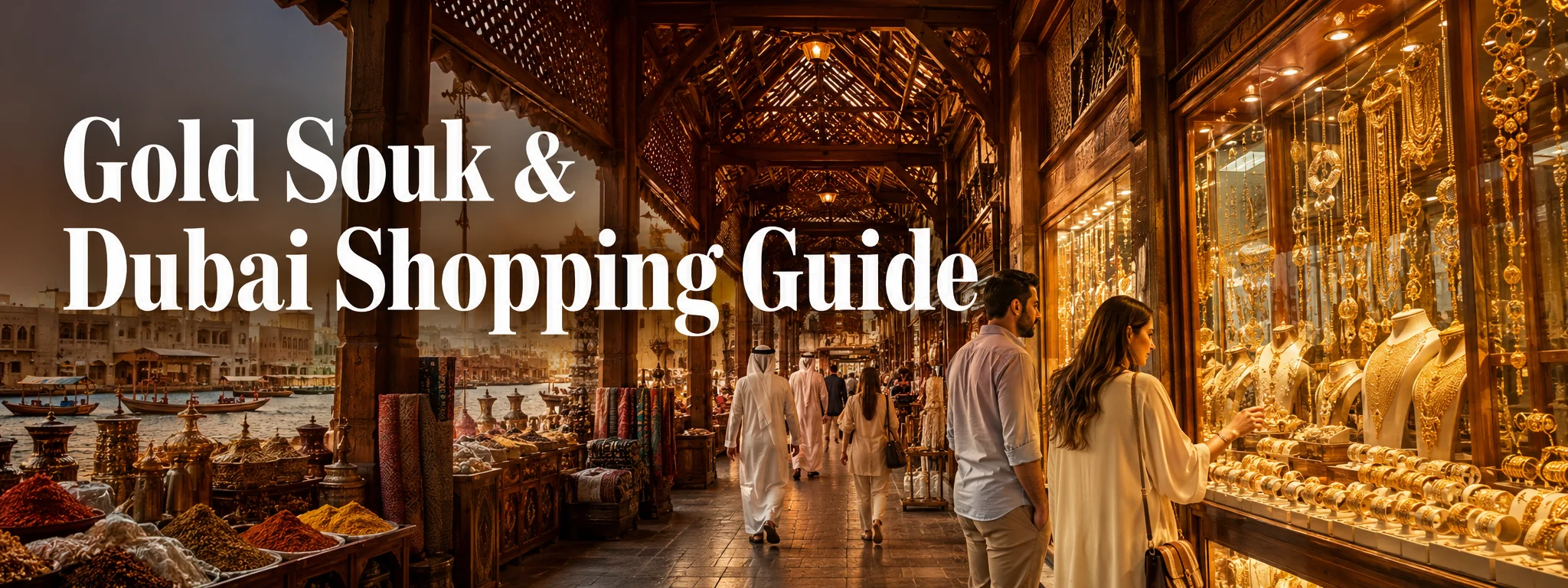
§ 01 — The Gold Souk
The world's most extraordinary gold market
Dubai Gold Souk in Deira is one of the city’s oldest and most fascinating traditional markets, with rows of specialist jewellery stores selling gold, gemstones, watches and elaborate wedding pieces. Visit Dubai continues to treat it as a headline traditional-market experience, but the reason to go is not a superlative or an old shop-count statistic. It is the concentration of jewellers, the visual spectacle and the ability to compare many pieces in a compact area.
Gold jewellery is not priced like a souvenir with one universal sticker formula. The final total can reflect the day’s metal value, purity or karat, weight, making or workmanship charge, stones, design complexity, brand and any other stated charges. Ask the shop to break the quote into those components. That makes comparisons far more useful than arguing over one headline number.
Do not assume every part of a quote is negotiable, and do not assume none of it is. Making charges and discretionary retail margins may have more room than the underlying metal component, but practice varies by shop and item. The strongest buying position is simply to understand the specification, compare equivalent pieces and be willing to walk away politely.

§ 02 — Gold prices & what things cost
What you'll actually pay
Gold moves constantly, so an evergreen guide should not quote a “2026 price” and pretend it remains useful. Check the current UAE retail reference rate on the day you shop, then compare pieces with the same purity and similar weight. The total you pay for jewellery is not just the raw metal value.
Ask the salesperson to write down the purity, weight, stone details where relevant, making or workmanship charge and final total. For a stone-set piece, request the stone specification too. If two rings look similar but one is substantially more expensive, this breakdown tells you whether the difference is weight, craftsmanship, stones or simply margin.
§ 03 — The Spice Souk & Textile Souk
The other souks worth your time
Spice Souk
A five-minute walk from the Gold Souk, through the covered lane between the two: sacks of saffron, dried limes (loomi), cardamom pods, frankincense resin, rose water, henna powder and sumac line the narrow corridor. The smell alone is worth the visit. Prices are reasonable — saffron in particular is significantly cheaper than in Western supermarkets. Good buys: loomi (dried limes) for cooking, high-grade saffron (ask to smell it — genuine saffron has an unmistakable floral-metallic scent), and frankincense incense blocks.
Textile Souk (Bur Dubai side)
Cross the Creek by abra to the Bur Dubai Textile Souk — a covered arcade of fabric merchants selling silk, cotton, lace, shawls and embroidered cloth. Quality and fibre content vary considerably, so buy the fabric in front of you rather than the story attached to it. Ask what the material is, compare several stalls and agree the unit and total price before cutting cloth. Bargaining may be possible at independent stalls, but there is no universal “correct” percentage.
§ 04 — Shopping by category
Best places to shop in Dubai
§ 05 — Buying gold well
A simple comparison method beats aggressive bargaining
Start by deciding what you are buying: wearable jewellery, a gift, a stone-set piece or an investment-style product. The questions are different. For jewellery, design and workmanship can be a meaningful part of the value; for an investment product, spread, purity and resale conditions matter more. Do not use one buying rule for both.
At the first shop, learn rather than negotiate. Ask to see two or three pieces in the purity and style you want. Get the weight and total price for each and ask how the quote is constructed. Then visit another established retailer and compare a genuinely similar piece. By the third shop you will have a much better sense of what is normal than any internet “bargaining hack” can give you.
If stones are involved, separate the gold decision from the gemstone decision. A diamond or coloured stone can account for much of the price, and two pieces with similar gold weight can therefore be incomparable. Ask about stone type, treatment and grading documentation. If the purchase is significant, do not be embarrassed to leave, research the specification and come back.
Before paying, check the finished item carefully. Confirm clasp, ring size, engraving, stone security and any promised resizing. Make sure the invoice matches what you were told and includes enough detail to identify the piece. Photograph the paperwork and keep the original separate while travelling.
§ 06 — Make it an Old Dubai half-day
The Souk is better when it is part of the Creek
I would not cross Dubai solely to spend twenty minutes under the Gold Souk roof. Pair it with the Spice Souk, Deira waterfront and an abra crossing to Bur Dubai. The traditional Creek abra routes currently cost AED 2 per stop on the core old-Dubai crossings, making the boat ride one of the easiest ways to connect the two sides.
A morning version works well in hotter months: start around Al Fahidi or Al Seef, cross the Creek, browse spices and gold, then stop for lunch before the temperature peaks. An evening version is more atmospheric for travellers who care more about lights and street energy than photography. In either case, verify retailer hours rather than planning around an old universal timetable.
Carry a small amount of cash for low-value market purchases and transport, but do not assume cash is necessary for a major jewellery transaction. For a large purchase, use a payment method that gives you a clear record, check card limits in advance and understand any foreign-exchange fees from your bank.
Dress for walking rather than the mall. The souk area is compact but the most interesting route involves lanes, waterfront sections and repeated stops. In summer, add water, shade breaks and an indoor lunch. If mobility is limited, shorten the route and use taxis between the banks rather than making the day a test of endurance.
§ 07 — Shopping tips
Practical advice
When to shop
Morning is comfortable for walking and comparing shops, while the souk becomes more atmospheric later in the day. Individual retailers and traditional markets do not all follow one permanent schedule, particularly around prayer times, public holidays and religious periods. Check current opening information for any specific shop you are travelling to visit.
Bargaining — where it applies
Negotiation is common in some independent market settings, but there is no reliable rule such as “offer half and settle at two-thirds”. Ask for the price, understand what is included, compare another seller and make a calm counter-offer if appropriate. Chain stores and fixed-price mall retailers are a different environment. In jewellery, focus on the itemised metal, workmanship and stone components rather than chasing an arbitrary discount percentage.
Authenticity & paperwork
For jewellery, inspect the purity marking, ask for the weight and specifications in writing, and keep the full invoice. For gemstones, ask exactly what documentation accompanies the stone before treating any verbal description as a certification. For branded fashion or watches, buy through an authorised retailer if authenticity and warranty support matter. A price that seems impossible for a genuine luxury product is a reason to slow down, not a reason to rush.