§ 01 — Why this part of Dubai matters
Old Dubai is not a museum set — it is the city still doing business
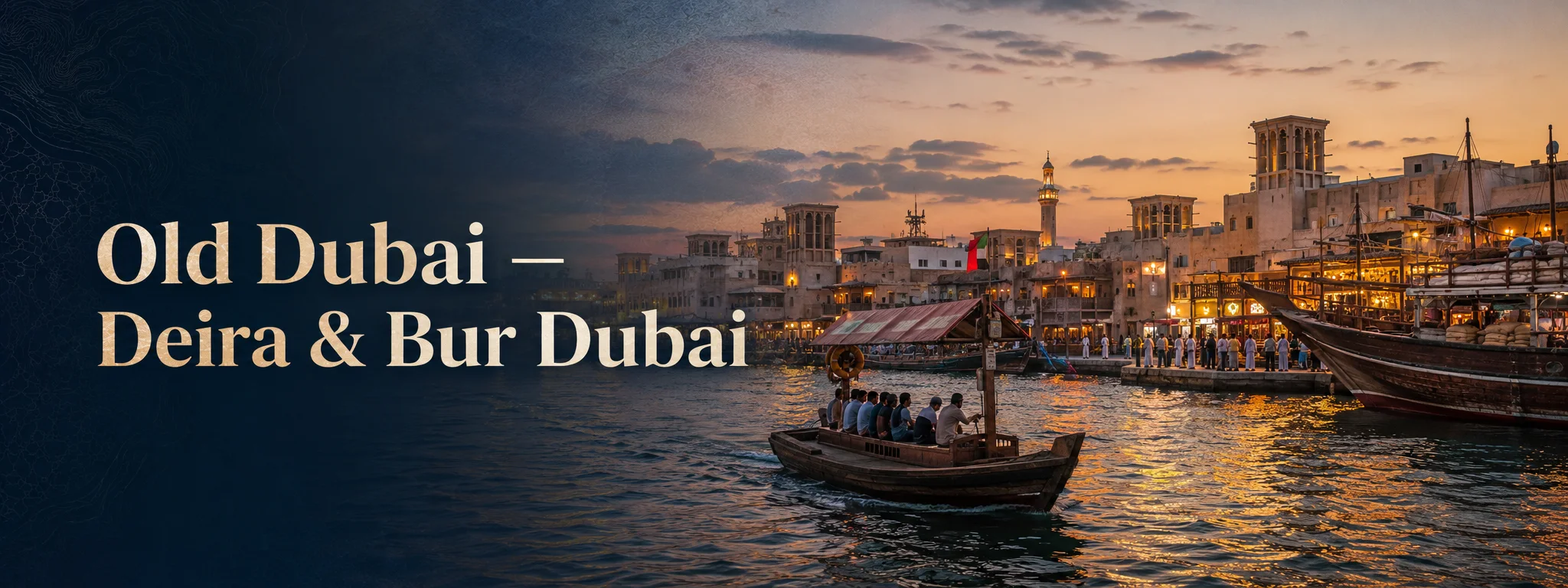
The most rewarding way to understand Dubai is to spend a few hours on both sides of the Creek. Deira and Bur Dubai are often bundled together as “Old Dubai”, but they feel different on the ground. Deira is the busier trading side: jewellery, spices, wholesale shops, small restaurants, delivery trolleys and commuters moving through streets that can feel gloriously untidy after the engineered calm of Downtown. Bur Dubai gives you the heritage lanes of Al Fahidi, textile shops, museums and cultural programmes, with Al Seef and Al Shindagha extending the waterfront story.
This is not “old” in the sense that every building is ancient. Much of the area has been rebuilt, adapted or commercialised. What survives is more interesting than a frozen heritage district: the Creek is still a transport corridor, the souks still trade, and the neighbourhood still reflects the migration and commerce that made Dubai prosperous long before the skyline became its global image.
If you only have time for one heritage half-day, choose this over a generic city tour. You can cross the Creek for the price of a small coin, walk through a late-19th-century neighbourhood, eat exceptionally well without a luxury-hotel bill, and see how tightly the maritime, mercantile and immigrant stories of Dubai fit together.

§ 02 — The Creek
Use an abra as transport, not as a staged attraction
The traditional abra crossing is the simplest memorable experience in central Dubai. RTA currently lists the classic Bur Dubai–Deira Old Souq (CR1) and Dubai Old Souq–Al Sabkha (CR2) crossings at AED 1 per passenger, paid in cash. Other Creek routes use different fares and payment arrangements, so do not assume every boat labelled “abra” is the one-dirham crossing.
The ride is short, but it changes the geography of the city immediately. From the water you can read the Creek as a working inlet rather than a photo backdrop: wooden dhows, marine stations, low-rise commercial blocks and the denser fabric of the old trading quarters sit almost at water level. It is also useful transport. Instead of taking a taxi around the Creek, cross it and continue the day on foot.
For a first visit, start on the Deira side near the Gold and Spice souks, then cross toward Bur Dubai. RTA timetables and holiday schedules can change, particularly around Ramadan and public holidays, so check the live marine timetable rather than building a day around an old screenshot.
§ 03 — Deira
Gold, spices and the working-city energy people come here for
The Gold Souk is visually outrageous in the best way: window after window of necklaces, bangles, coins and elaborate bridal pieces. The useful thing to understand is that jewellery shopping here has two components. The underlying gold value is tied to weight and purity; the negotiable part is often the making charge and retailer margin. If you are buying rather than browsing, compare several shops, ask for weight and karat clearly, and never let the theatrical scale of the displays rush you into a purchase.
The nearby Spice Souk is smaller and more sensory. Saffron, dried limes, cardamom, dates, nuts, incense and teas spill into the lanes. It is worth visiting even if you buy nothing, but this is still a marketplace rather than a theme park. Ask before photographing people closely, keep bargaining good-natured, and remember that the first price offered to a visitor is not necessarily the final one.
Deira becomes more interesting when you walk beyond the postcard stops. Streets around Al Ras and the Creek reveal wholesale trading, inexpensive restaurants and the everyday service economy that tourism brochures usually crop out. That contrast is the point. Old Dubai is strongest when you stop looking for a single “heritage attraction” and start reading the neighbourhood itself.
§ 04 — Al Fahidi
Walk slowly through the wind-tower lanes
Al Fahidi Historical Neighbourhood is the architectural heart of a heritage day. Visit Dubai’s 2026 city guide notes that most surviving buildings here date from the late 19th century. The narrow passages, internal courtyards and barjeel wind towers are worth looking at as climate design, not merely as decoration: shaded lanes and passive ventilation made life more tolerable before air-conditioning.
Do not sprint through Al Fahidi on the way to a photo. The neighbourhood works better when you allow time for a gallery, a cultural programme, Arabic coffee or a quiet courtyard. The Sheikh Mohammed bin Rashid Al Maktoum Centre for Cultural Understanding (SMCCU) is based here and runs public cultural meals, heritage tours and other programmes hosted by Emirati presenters. Those experiences add context that an unguided walk cannot provide, particularly if you are curious about customs, faith and everyday Emirati life.
Do not assume Dubai Museum at Al Fahidi Fort is open. The fort, built in 1787 and converted into Dubai Museum in 1971, has been undergoing a major redevelopment. Current 2026 government material describes the project and a planned reopening during 2026, but a firm public reopening date should be verified before you travel. If the fort is closed, the district is still worth visiting; simply shift the museum component of your day toward Al Shindagha or other open heritage venues.
§ 05 — Al Seef and Al Shindagha
Know what is historic and what is heritage-inspired
Al Seef is useful, attractive and deliberately designed — but it should not be confused with untouched old Dubai. The waterfront development combines heritage-styled architecture with restaurants, shops and polished public space. That makes it an easy place for dinner or an evening walk after Al Fahidi, especially when the light softens and the Creek traffic becomes part of the view.
If you want deeper history, continue toward Al Shindagha. This end of the Creek is more directly connected to Dubai’s ruling-family, maritime and trading story, and its museum complex is a stronger substitute when Al Fahidi Fort is unavailable. The most satisfying route therefore moves from commerce in Deira, across the Creek by abra, through Al Fahidi’s domestic architecture and on toward the broader Creek story at Al Shindagha.
Trying to cover every museum, souk and waterfront block in one morning defeats the purpose. Pick one or two indoor stops and let the rest of the time remain unscheduled enough for wandering.
§ 06 — Eating well
Come hungry: the food map is wider than Emirati cuisine
One of the best reasons to linger in Old Dubai is that its food reflects the people who built and still run the commercial city. You will find Emirati dishes, Iranian grills, Indian and Pakistani biryani, South Indian breakfasts, Yemeni food, Filipino cooking, shawarma, fresh juices and sweets within a relatively small area. The concentration is far more interesting than treating “local food” as one expensive tasting menu.
For visitors, the useful strategy is to decide whether you want a heritage setting or a neighbourhood meal. Cafes around Al Fahidi offer atmosphere and make an easy break during a walking route. Deira and Bur Dubai’s commercial streets are better for inexpensive, everyday eating. Meena Bazaar is particularly dense with South Asian restaurants and snack shops; Deira’s Al Rigga and surrounding streets broaden the choice again.
Alcohol is not the organising principle here. Licensed hotel venues exist, but if drinks and late-night bars are the priority, Downtown, DIFC, Marina or JBR will usually fit the evening better. In Old Dubai, lean into tea, coffee, juice, grills and the pleasure of eating somewhere that is busy because residents use it.
§ 07 — A route that actually works
The half-day Old Dubai walk
Morning: take the Metro toward Al Ras and begin with the Gold Souk and Spice Souk before the hottest part of the day. Spend enough time to look, but resist turning each shop into a negotiation unless you are genuinely buying.
Late morning: walk to Deira Old Souq Marine Station and take the traditional abra across the Creek. Continue toward Al Fahidi Historical Neighbourhood. If you have booked an SMCCU programme, let that booking determine the timing; otherwise wander the lanes and choose one cultural stop.
Lunch: eat in Bur Dubai or around Al Fahidi. If you want a more resident-oriented meal, walk toward Meena Bazaar rather than defaulting to the most photogenic courtyard.
Afternoon or sunset: move along the Creek toward Al Seef and, if you still have energy, Al Shindagha. In the hottest months, reverse the rhythm: keep the midday period indoors and return to the waterfront later.
This route is intentionally compact. Adding Dubai Mall, the Frame and Downtown to the same day creates a checklist rather than an experience. Old Dubai rewards attention more than speed.
§ 08 — Getting around and staying comfortable
Old Dubai is walkable by Dubai standards — but the weather still decides the day
Metro access is one of Old Dubai’s strengths. Al Ras and Al Ghubaiba are useful Green Line anchors, while other stations can work depending on your exact route. Once you are in the historic core, walking plus an abra is usually more satisfying than repeatedly ordering cars for short hops.
That does not mean the day is effortless in summer. Shade is inconsistent, pavements can be busy, and temperatures can make even a two-kilometre walk punishing. From late spring through early autumn, start earlier, plan air-conditioned breaks and carry water. In the cooler season, the same route can comfortably expand into a full day.
Dress for a city neighbourhood rather than a resort pool. Lightweight clothing is sensible, but more modest coverage is useful around religious and cultural sites. If you are entering a mosque or joining a structured cultural visit, follow that venue’s specific dress instructions.
§ 09 — Who will love it
The part of Dubai that converts sceptics
Old Dubai is especially good for travellers who think Dubai is only malls, supercars and skyscrapers. It is not a rebuttal to modern Dubai — the two stories are connected — but it gives the city texture. The Creek explains trade. The souks explain commercial instinct. Al Fahidi explains climate and domestic architecture. The restaurants explain migration. The abras show that some of the city’s most useful transport is also its most atmospheric.
Families can make the day engaging by using the boat crossing and choosing one museum rather than several. Photographers should come early or late for softer light but remember that working markets are not sets. History-focused travellers should add Al Shindagha. Food-focused travellers can easily spend longer in Deira and Bur Dubai than in the formal heritage sights.
Sources freshly checked 11 September 2026: RTA current traditional-abra routes and fares; Visit Dubai’s 2026 Old Dubai, Al Fahidi, Al Seef and Gold Souk guidance; UAE Ministry of Culture material on the Al Fahidi Fort redevelopment; and current SMCCU programme/contact information. Recheck museum openings, cultural-programme times and marine timetables close to travel.