§ 01 — Why this visit matters
Jumeirah Mosque is a conversation, not a photo stop
Jumeirah Mosque is one of the few mosques in Dubai with a formal programme designed for non-Muslim visitors, and that distinction matters. You are not merely being allowed to stand quietly at the back of a religious building. The visit is run as a cultural exchange by the Sheikh Mohammed bin Rashid Al Maktoum Centre for Cultural Understanding (SMCCU), whose long-standing motto is “Open Doors, Open Minds.”
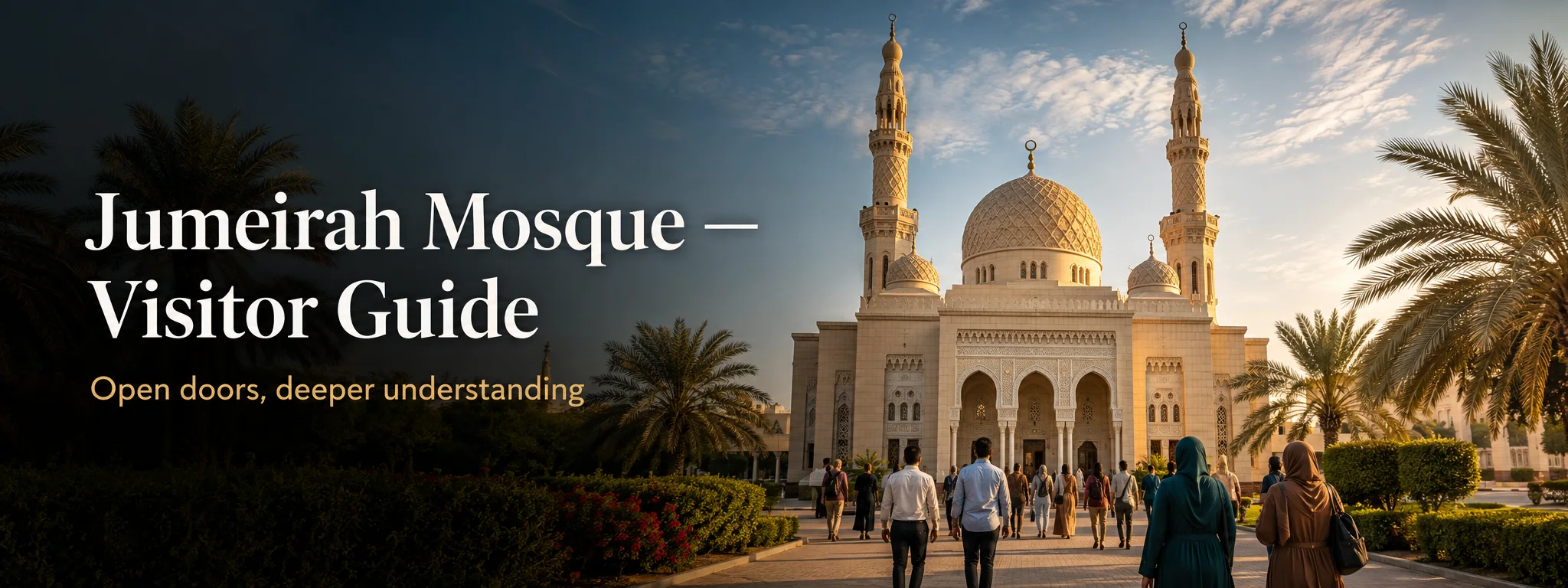
The architecture is beautiful — pale stone, twin minarets, a balanced central dome and the symmetry that makes the mosque especially photogenic in soft morning or late-afternoon light — but the real value is the presenter. The programme explains what happens in a mosque, how Muslims pray, how religious practice connects with Emirati life and, crucially, leaves room for visitors to ask the questions they are usually too embarrassed to ask.
If you have time for only one organised cultural experience in Dubai, I would put this ahead of another observation deck. It gives context to the call to prayer you hear across the city, the clothing you see, Ramadan, hospitality and the rhythm of religious life. You leave with a better vocabulary for understanding Dubai rather than simply another photograph of it.
§ 02 — Current schedule
Two public visits a day, Saturday to Thursday
The dedicated Jumeirah Mosque website currently lists guided public visits at 10:00am and 2:00pm, Saturday to Thursday, with Friday closed. Registration opens 30 minutes before each session and the programme lasts about 1 hour 15 minutes. The official page says advance booking is not required for the standard public visit.
That makes the practical arrival target 9:30am for the morning session or 1:30pm for the afternoon session. I would still arrive a little earlier if the visit is important to you, especially in the cooler peak season or during school-holiday periods. You need time to register, sort clothing if necessary, use the facilities and settle rather than sprinting in as the presentation starts.
Morning is my preference. The light is often kinder for the exterior, you avoid building your whole day around an afternoon appointment, and you can continue south along the Jumeirah coast or north toward Old Dubai afterwards. The 2pm session is useful if you have a slow breakfast or are staying nearby.
§ 03 — Price: note the live discrepancy
Official pages currently disagree, so verify before you go
This is exactly the kind of detail a responsible travel guide should not pretend is settled. As checked on 11 September 2026, the dedicated Jumeirah Mosque public-visit page lists admission at AED 55 per person, while the SMCCU programme page still shows AED 45. Both are official properties associated with the programme.
Rather than choosing whichever number makes a cleaner article, I would treat the fee as live and confirm it on the dedicated mosque page or with SMCCU immediately before visiting. The discrepancy is small, but the principle matters: Dubai attraction prices and packages can change faster than editorial copy.
The dedicated mosque page says the admission includes light Emirati refreshments and Majlis activities. The broader website also references elements such as Emirati refreshments and cultural activities. The exact mix can evolve, so come for the guided conversation rather than calculating the ticket value from a checklist of extras.
§ 04 — What actually happens
Registration, hospitality, mosque visit and questions
Registration takes place around the mosque’s visitor/majlis facilities rather than beginning with a silent march straight into the prayer hall. That matters because hospitality is part of the programme. Current official material describes light Emirati refreshments before the presentation, creating a natural opening for conversation and helping visitors understand that food and coffee are part of Gulf welcome, not decoration.
Inside the mosque, the presenter explains the prayer space and practices such as wudu, the ritual washing performed before prayer. You will hear about the five daily prayers, the direction of prayer, the role of the imam and the basic physical sequence of worship. Good presenters connect those facts with ordinary life rather than leaving them as theology vocabulary.
The Q&A is the reason to stay engaged. Questions about Ramadan, the five pillars, clothing, women’s roles, the difference between religion and local custom, prayer, fasting and family life are all within the spirit of the programme. You do not need to agree with every explanation to listen respectfully. Cultural understanding is not the same thing as cultural endorsement; it starts with asking people to explain themselves in their own space.
§ 05 — Dress code
Modest clothing is required; garments are available
The mosque’s official dress-code page is clear. Men should avoid shorts and sleeveless tops. Women should cover arms, legs and hair. The visitor programme provides traditional clothing when needed: abayas and sheilas/headscarves for women, and kanduras for men. The Centre says those garments are cleaned and maintained for visitors.
The easiest approach is still to arrive mostly ready. For men, lightweight long trousers and a T-shirt or shirt with sleeves are simple. For women, a loose long dress, trousers with a long-sleeved top, or another outfit covering arms and legs reduces the amount you need to borrow. Bring your own scarf if you prefer using one you already know how to arrange, although head covers are available.
Shoes are removed before entering the prayer area. Wear socks and footwear that comes off easily. Avoid arriving with your entire day packed into complicated boots, dangling beach gear and a giant shopping haul; the calmer you make the transition into the mosque, the better the visit feels.
§ 06 — Photography
Yes, photos are part of the public programme — still use judgement
The dedicated Jumeirah Mosque page explicitly presents photography as part of the welcoming public visit. That is unusual enough to be worth appreciating. You can photograph the architecture and, when the presenter indicates it is appropriate, document parts of the experience.
Do not turn permission into entitlement. Ask before taking a close portrait of another visitor or staff member. Do not block the group while composing twenty versions of the same doorway. During explanation or reflective moments, put the phone down occasionally. The most valuable thing you take from the mosque should be an improved understanding of the people who use it, not a memory card full of strangers.
For exterior photographs, the building reads beautifully from across Jumeirah Beach Road and from angles that keep the twin minarets balanced. Early light is generally softer than the middle of the day. Be cautious around traffic when moving for a wider frame; this is a functioning urban road, not a pedestrianised photo set.
§ 07 — Architecture without the mythology
Look at proportion, stone and function
Jumeirah Mosque is commonly described as drawing on Fatimid architectural traditions. The useful way to look is not to memorise a style label but to notice how the building organises attention: the minarets mark the skyline, the dome anchors the centre, repeated arches create rhythm and the pale stone changes character as the light changes.
Inside, ask the presenter to point out the mihrab, which indicates the direction of prayer, and explain how the space is used when the congregation gathers. Listen to how ornament works without figurative religious imagery. Architecture makes more sense when connected to function.
The mosque is also a useful counterweight to Dubai’s newer monumental architecture. Burj Khalifa and Museum of the Future often get discussed as engineering and branding objects; Jumeirah Mosque asks you to read a building through ritual, community and repetition. That contrast makes a day in Jumeirah much richer.
§ 08 — Getting there
Jumeirah Beach Road is easy by taxi, less direct by Metro
The mosque is on Jumeirah Beach Road in Jumeirah 1. For most short-stay visitors, a taxi or ride-hailing car is the simplest option because there is no Metro station beside the entrance. If you are using public transport, check the current RTA journey planner for the best bus connection from your starting point rather than copying a fixed route number from an old blog.
Build in road time. Jumeirah Beach Road can be busy, and “ten minutes away” is a dangerous phrase in Dubai once traffic, hotel pickup and a wrong entrance are involved. Because registration opens half an hour before the tour, use that buffer rather than planning to arrive exactly at 10:00.
If you are driving, verify current parking arrangements on the mosque or maps listing before departure. Visitor traffic can change during religious events and busy periods.
§ 09 — Build a Jumeirah day around it
Mosque first, coastline second
The morning visit works beautifully as the cultural anchor for a Jumeirah day. Afterwards, continue along the coast for a beach walk, café or lunch, then choose one bigger afternoon stop rather than racing between landmarks. Our Jumeirah guide explains how the district stretches far beyond a single beach and why road geography matters.
If you want a deeper heritage day, combine the mosque with Al Fahidi and the Creek rather than with another luxury-hotel attraction. The two experiences complement each other: Jumeirah Mosque explains contemporary religious practice, while Old Dubai gives you the trading-city and domestic architecture context.
If food is the bridge you prefer, have an Emirati breakfast or lunch and read our Emirati cuisine guide. The conversation around hospitality, coffee, dates and Ramadan will make more sense after you have heard it from a cultural presenter.
§ 10 — Families, accessibility & respectful questions
Who gets the most from the visit
Curious older children and teenagers can get a great deal from the programme because the format is conversational rather than museum-heavy. Before bringing very young children, consider whether they can sit through a 75-minute guided experience without making the prayer space difficult for other visitors. Contact SMCCU if you need current advice on family participation.
Travellers with mobility or sensory requirements should also contact the programme directly before arrival. Do not assume that an historic-style religious building or every part of a cultural activity has the same accessibility as a new mall. A quick message can clarify entrances, seating and assistance far better than a generic accessibility badge.
Finally, ask real questions. “Why do Muslims pray five times a day?” is useful. “Is every Muslim/Emirati like this?” is not. The presenter is explaining a faith and a culture, not certifying that millions of people think identically. Good cultural travel leaves room for variety.
§ 11 — Before you leave the hotel
The five-minute check
Confirm that it is not Friday; check the current 10am/2pm schedule; verify the live admission fee because the two official pages currently conflict; wear or carry modest clothing; leave enough time to register 30 minutes early; and save the mosque/SMCCU contact details in case your plans change.
That is all the preparation you need. Do not overcomplicate it. Jumeirah Mosque works because the programme removes barriers between visitors and a subject many people approach nervously. Show up on time, listen, ask, and let the experience do its job.