§ 01 — Start with the right expectation
Emirati food is not the same thing as “Arabic food”
Dubai is one of the easiest cities in the world in which to eat Lebanese mezze, Palestinian grills, Iranian kebabs, Indian biryani or Pakistani breakfast. None of those cuisines is interchangeable with Emirati food. The UAE’s own cooking is quieter on restaurant menus, rooted in the Gulf coast, desert hospitality and centuries of trade, and that is exactly why it is worth seeking out deliberately.
At its best, Emirati cooking is generous rather than showy: rice scented with spices and dried lime, slow-cooked meat, fish from the Gulf, wheat dishes that reward patience, thin breads, dates, cardamom coffee and sweets built around saffron, syrup and texture. You will taste connections with Persia, India, East Africa and the wider Arabian Peninsula, but the combinations and social rituals are distinctly local.
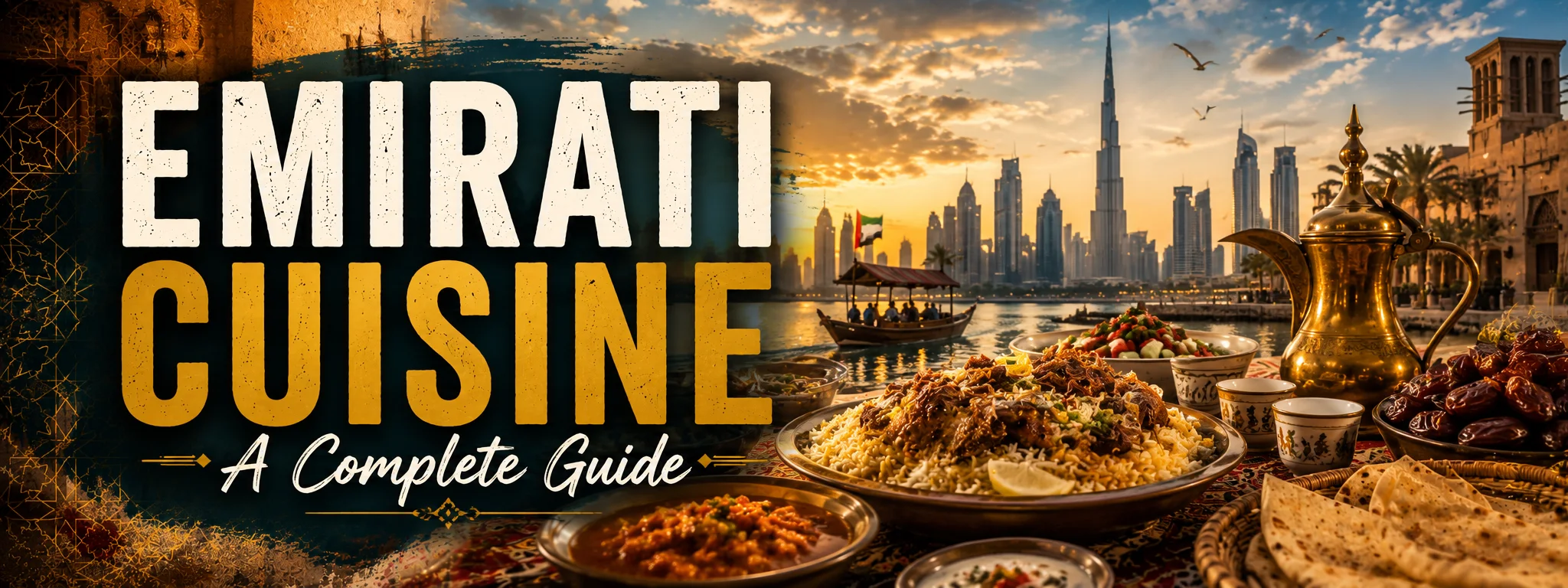
The useful traveller mindset is to stop looking for a single “national dish” and instead build one or two meals around the dishes that explain the cuisine. Machboos teaches you the rice-and-spice foundation; harees shows the importance of slow cooking and ceremonial food; balaleet makes sense of the Emirati sweet-savoury breakfast palate; luqaimat gives you the irresistible snack version. Add Arabic coffee and dates and you have a much better introduction than a generic mixed grill.
§ 02 — The essential dishes
What to order, and why each dish matters
Machboos: the benchmark rice dish
Machboos — you will also see spellings such as majboos — is the dish I would use to judge a traditional Emirati kitchen. Long-grain rice is cooked with meat, chicken or fish and a warm spice profile that can include loomi, cardamom, cinnamon, cloves, cumin, coriander and saffron. The best versions are aromatic without tasting like a spice cupboard: the rice carries the flavour of the stock and protein, while the dried lime gives a sour, almost smoky edge that stops the dish becoming heavy.
For a first order, lamb or chicken is easy to understand; fish makes more sense once you have spent time around the Creek and realise how strongly old Dubai was tied to the sea. Do not drown the rice in sauce before tasting it. Part of the pleasure is noticing how much flavour has already been absorbed into the grains.
Harees: simplicity that takes time
Harees combines wheat and meat and is cooked until the ingredients become a smooth, cohesive porridge-like dish, traditionally finished with ghee. It is especially associated with Ramadan, Eid, weddings and family occasions. On paper it can sound plain; in practice its appeal is texture, warmth and the depth that comes from long cooking. It is a good counterpoint to Dubai’s obsession with spectacle because there is nowhere for technique or ingredient quality to hide.
Thareed: bread, broth and the logic of hospitality
Thareed layers or combines thin bread with a meat-and-vegetable stew so the bread absorbs the broth. It is another dish closely associated with Ramadan and family tables. Think of it less as a restaurant “signature” and more as a lesson in how bread, stock and sharing turn modest ingredients into a deeply satisfying meal. If you find it on a traditional menu, order it alongside rice rather than instead of rice; the textures are completely different.
Balaleet: breakfast that breaks the sweet-versus-savoury rule
Balaleet is one of the dishes visitors remember because it refuses to fit familiar categories: sweet vermicelli scented with cardamom and saffron is paired with egg. The result can read as breakfast, dessert and savoury main course in the same forkful. It is best approached with an open mind and a small portion first. If you like Southeast Asian or South Asian sweet-savoury combinations, it may feel less strange than the description suggests.
Luqaimat: eat them immediately
Luqaimat are small fried dough balls served hot, commonly with date syrup or other sweet toppings. Their entire appeal is the contrast between a crisp exterior and a soft centre, so this is not the dish to photograph for ten minutes while it cools. They are widely associated with Ramadan and festive gatherings but are also easy to find year-round at traditional restaurants and heritage-oriented cafés.
§ 03 — Breakfast, bread and coffee
The meal that often teaches you more than dinner
A traditional breakfast is a smart way into Emirati food because the flavours are clear and the meal is less likely to be buried under hotel theatrics. Look for chebab, a lightly spiced local pancake often served with date syrup or cheese; regag, a very thin crisp bread cooked on a hot surface and eaten with savoury or sweet accompaniments; and balaleet. A breakfast spread lets you compare soft, crisp, sweet, salty and aromatic elements in a way a single plate of machboos cannot.
Then pay attention to gahwa, Arabic coffee. It is usually lighter in colour and body than espresso, scented with cardamom and sometimes other aromatics, and served in small cups. The important part is not caffeine; it is hospitality. Coffee and dates are part of the rhythm of welcoming guests. Accepting a small cup, drinking it slowly and watching how it is poured will tell you more about Gulf hosting culture than another list of etiquette rules.
If you want to stop, a small shake of the cup is a commonly understood signal. You do not need to perform customs theatrically or worry about getting every gesture perfect. Be observant, gracious and interested. Good hosts are not waiting to catch visitors out.
§ 04 — Learn the flavour map
Loomi, saffron, cardamom and the Gulf pantry
Loomi — dried lime — is the flavour I tell travellers to notice first. It can be used whole, pierced, ground or infused into stews and rice, bringing acidity and a deep fermented-citrus note without tasting like fresh lime juice. Once you recognise it, you start noticing it across Gulf cooking.
Cardamom is equally important but appears in both savoury and sweet directions, especially coffee. Saffron can perfume rice, breakfast dishes and sweets; cinnamon, cloves and cumin may appear in spice mixtures; rose water is common in desserts. Dates are eaten on their own, served with coffee and worked into modern desserts. Fish, meanwhile, is the part of the cuisine many short-stay visitors miss because Dubai’s global restaurant scene has trained them to think first about steak and brunch rather than the Gulf.
Do not assume every traditional dish will be aggressively spiced. Emirati food is often fragrant rather than chilli-hot. If you equate “spicy” with heat, ask the server to explain the dish before ordering. The more interesting conversation is usually about aroma, sourness, smoke, sweetness and texture.
§ 05 — Where to eat
Choose the setting for the lesson you want
Al Fanar Restaurant & Cafe remains one of the most straightforward introductions for visitors. Visit Dubai continues to list it as an Emirati restaurant, and the concept deliberately evokes an earlier era of local life. It is the place I would choose when your priority is a broad menu and the ability to compare several traditional dishes in one sitting.
Arabian Tea House in Al Fahidi is valuable for a different reason: the heritage-neighbourhood setting connects breakfast, tea and local-style dishes with the lanes and wind-tower architecture of Old Dubai. It is popular and polished rather than a secret local canteen, but that does not make it useless. Go early, order breakfast rather than only tea, then walk Al Fahidi and the Creek while the food context is still fresh in your mind.
For a deeper cultural exchange, check the current programmes at the Sheikh Mohammed bin Rashid Al Maktoum Centre for Cultural Understanding. Its public experiences are built around conversation as much as consumption. A hosted cultural meal or hospitality programme can be more valuable than chasing a supposedly “hidden gem” because you can ask why dishes are served, what changes during Ramadan and how food fits into family life.
Restaurant openings, branches and menus change quickly in Dubai. That is why this guide deliberately does not promise a fixed list of prices or branch-specific dishes. Use the official venue page on the day you plan to go and treat the dishes above — not a decade-old restaurant ranking — as your anchor.
§ 06 — How to order well
Build a table, not a pile of famous dishes
For two people, I would usually build around one rice dish, one slower wheat/broth dish if available, a bread or breakfast-style item, vegetables or salad, then one sweet and coffee. For a family or group, sharing becomes even more useful because Emirati cuisine rewards comparison. Ask the server what is particularly local rather than simply asking for “the most popular thing”.
If a restaurant also serves Lebanese, Indian or pan-Arab dishes, do not let familiar favourites crowd out the reason you came. Hummus, shawarma and grilled meats can be excellent, but they will not teach you much about Emirati cooking. Ask which dishes are specifically Emirati and which are broader regional staples.
Dietary needs require a little planning. Halal meat is the norm, but traditional menus can be meat- and rice-heavy. Vegetarians can often make a good breakfast or sweets-and-snacks meal, yet a full traditional vegetarian dinner may offer less range than the city’s international restaurants. For allergies, do not infer ingredients from an English menu description: nuts, sesame, dairy, wheat and spice blends can appear in sauces, breads and desserts. Explain the allergy clearly and ask staff to confirm with the kitchen.
§ 07 — Turn lunch into a neighbourhood day
The best food context is Old Dubai
If your itinerary allows it, connect Emirati food to Old Dubai. Have breakfast or an early lunch around Al Fahidi, walk the historical neighbourhood, cross the Creek by abra and spend time in the souqs. The point is not nostalgia: modern Dubai grew from a trading city, and food makes much more sense when you have seen the water, boats, imported spices and compact urban fabric that supported that trade.
A second meal can then be modern rather than traditional. Dubai’s contemporary chefs increasingly use local dates, camel milk, Gulf seafood and Emirati flavours in new formats. That contrast — heritage meal first, modern interpretation second — is more interesting than eating four “authentic” meals in a row and pretending cuisine stopped evolving in 1971.
During Ramadan, food becomes even more socially meaningful. Iftar and late-evening dining can be memorable, but timings, programmes and restaurant operations change each year. Read our Ramadan guide and check current official listings rather than relying on last year’s iftar schedule.
§ 08 — Sources & final advice
Eat with curiosity, not a checklist
The easiest mistake is to treat Emirati cuisine as another attraction to “do”. Slow down. Ask what a dish is eaten with, whether it is everyday food or celebration food, why loomi is used, what changes during Ramadan, and which breakfast the server grew up eating. Those questions turn a plate into a conversation.
For current venue and cultural-programme details, I cross-checked Visit Dubai’s Emirati cuisine and restaurant guidance plus the SMCCU’s current cultural experiences. Menus and programme schedules can move faster than editorial pages, so verify the exact branch or event before travelling across town.