§ 01 — Why the Frame is worth doing
A cheaper observation experience with a clear old-Dubai/new-Dubai story
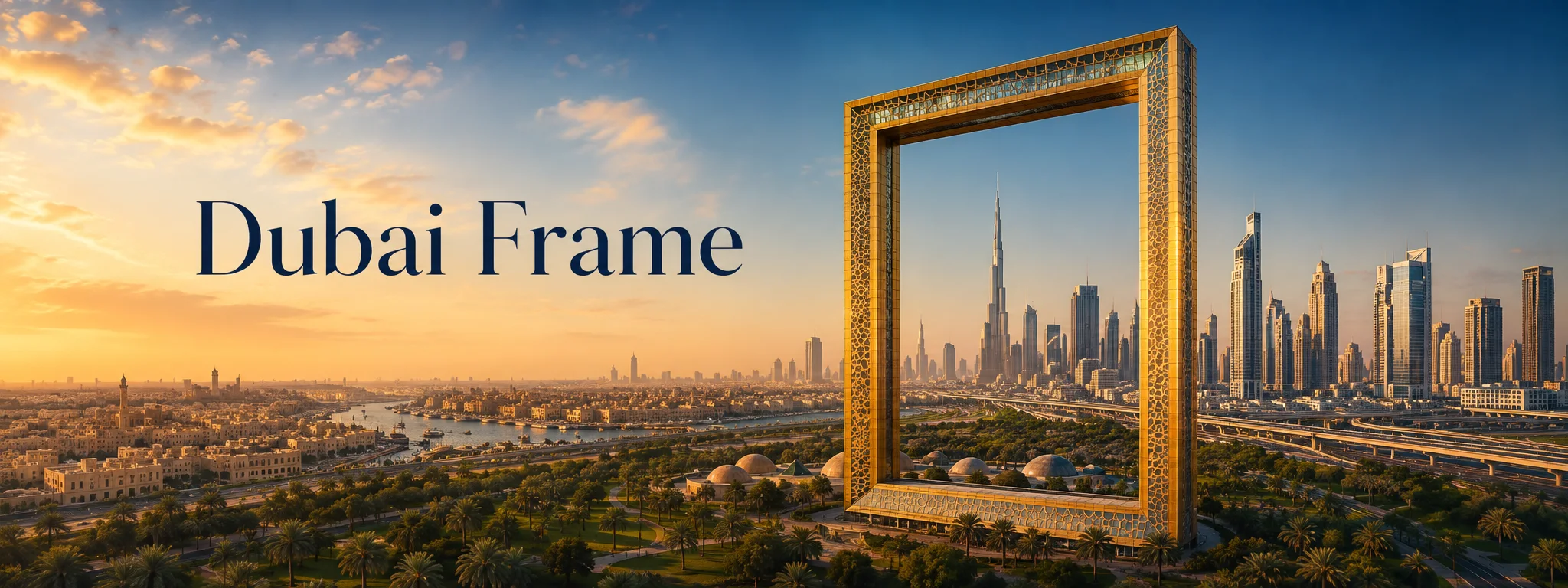
Dubai Frame stands at Zabeel Park as two 150-metre towers joined by a sky bridge. The appeal is not simply height. From the top, the attraction deliberately contrasts older neighbourhoods and the Creek side of the city with the modern skyline towards Downtown and Sheikh Zayed Road. That makes it more interpretive than a conventional observation deck.
It is also unusually straightforward by Dubai-attraction standards. The official site currently lists daily opening from 8:00am to 9:00pm, adult admission of AED 50 and child admission (ages 3–12) of AED 20. Infants under three are free. Hours may vary around Ramadan and public holidays, so re-check before travelling.
If Burj Khalifa is your once-only skyline priority, do that first. Dubai Frame is the better choice when you want a shorter, cheaper visit with history, city context and a glass-floor element.
§ 02 — What happens inside
Past, skyline, glass bridge, future
The route starts with exhibits introducing Dubai's past, then lifts you to the sky bridge. At the top, spend time looking in both directions rather than treating the crossing as a photo queue. The glass-floor sections are the physical thrill, but the city geography is what makes the Frame distinctive.
After the observation level, the experience continues with future-focused displays. They are part museum, part civic vision statement; enjoy them as a designed narrative rather than expecting a neutral urban-history exhibition.
Most visitors can cover the attraction in about 60–90 minutes. Add buffer if you are visiting near sunset, at a weekend or during a busy holiday period.
§ 03 — Tickets and queues
Advance booking is sensible at busy times
The official FAQ recommends pre-booking, especially on weekends, and asks timed-ticket visitors to arrive around 10–15 minutes before admission. That is better guidance than old claims that advance booking is never necessary. Capacity is controlled and the official ticketing system displays availability by date.
Current standard prices published by Dubai Frame are AED 50 for adults and AED 20 for children aged 3–12. People of Determination with qualifying UAE-issued cards receive complimentary entry with up to two companions under the attraction's stated policy; confirm eligibility details before relying on it.
Do not build a plan around third-party “skip-the-line” promises unless the product clearly explains what is different from the normal timed ticket.
§ 04 — Bags, prams and rules
Travel light
Dubai Frame currently says large bags and strollers must be left at the Gate 4 counter. Food and drink are not allowed inside, pets are prohibited, and children under 12 must be accompanied by an adult. Personal handbags and purses are allowed, while larger shopping, sports and backpack-style bags may need to go to baggage storage.
Those rules make a difference if you are arriving with airport luggage, shopping bags or a sleeping child in a stroller. Sort storage before joining the admission flow rather than discovering it at the lift.
The attraction states that wheelchair service is available on request and lists accessible passages, reserved parking, adapted restrooms and service counters for People of Determination.
§ 05 — Getting there
Use Zabeel Park Gate 4 as the destination
Dubai Frame is at Zabeel Park Gate 4. The official site points visitors towards Al Jafiliya Metro Station; from there you still need to complete the final approach to the park entrance. A taxi or ride-hailing car is easier in extreme heat or for travellers with mobility limitations.
Do not assume every Zabeel Park gate is equally convenient. Put “Dubai Frame, Zabeel Park Gate 4” into your map or taxi destination to avoid an unnecessary walk around the park boundary.
§ 06 — Best time
Morning for efficiency; late afternoon for atmosphere
Morning is the easiest choice for smaller crowds and less outdoor heat. Late afternoon can give you daylight views, warmer exterior light and city lights if you stay through dusk, but it is also a more popular window. In dusty or hazy weather, long-distance skyline visibility can be limited no matter how perfectly you time the ticket.
If you are combining the Frame with Old Dubai, use the visit as a geographic transition: Frame first, then continue towards Bur Dubai/Creek, or do the historic districts first and finish at the Frame before sunset.
§ 07 — Is it worth it?
Yes, especially for first-time visitors who want context
At the current official standard price, Dubai Frame remains one of the easier major attractions to justify. You get an observation experience, a memorable glass-floor crossing and a simple visual explanation of how the city expanded.
Re-check the official site on the day for hours, ticket availability and holiday changes. The core attraction is stable; operating details are not.
§ 08 — How the visit flows
The attraction is short enough to pair, but not a ten-minute photo stop
The Frame is designed as a sequence. You move through a past-Dubai presentation, rise to the Sky Deck, cross the bridge with views to both sides of the city, then descend through a future-focused finale. If you skip the interpretation and only chase the glass-floor photo, you miss the reason the attraction works better than a generic observation deck.
Around 60–90 minutes is a sensible planning range for many visitors, but leave more room around sunset and weekends. The official ticket system is timed and the FAQ asks visitors to arrive 10–15 minutes before their slot. That is enough reason not to book another attraction immediately afterwards.
For photographers, visibility matters more than the precise minute of sunset. Dubai haze can flatten distant views. If the skyline is the entire purpose of the visit, check conditions before committing to a premium transport plan.
§ 09 — Dubai Frame vs Burj Khalifa
Choose context or height
Burj Khalifa wins on height, global-icon status and the feeling of being above Downtown. Dubai Frame wins on simplicity, lower standard admission and the literal framing of old and new Dubai from one bridge.
On a first visit of three days or longer, doing both is reasonable if skyline attractions matter to you. On a 48-hour trip, I would usually choose one based on the rest of the route: Frame fits naturally with Zabeel Park and Old Dubai; Burj Khalifa fits with Dubai Mall and Downtown.
Families who dislike long queues or expensive add-ons may find the Frame easier to justify. Travellers chasing the single most famous view should save their observation-deck budget for Burj Khalifa.
§ 10 — Accessibility and family planning
The rules are manageable if you know them before Gate 4
Dubai Frame's current official information lists complimentary entry for People of Determination with up to two companions and describes accessible passages and services. The FAQ also confirms that larger backpacks and similar bags need to be stored, while food and drink are not allowed inside.
That matters most for families arriving with a stroller, shopping or day-trip luggage. The attraction's rules state that strollers and large items may need to be left at the Gate 4 counter, so a sleeping toddler can change the plan. Travel light and use a carrier if that works for your family.
Children under 12 need adult accompaniment. For nervous children, the glass-floor section can be treated as optional; the city views do not require anyone to stand on transparent flooring.
§ 11 — Pairing it with Old Dubai
Use the Frame as the bridge between two versions of the city
The best thematic pairing is Old Dubai. Spend part of the day around Al Fahidi, the Creek and Deira's souqs, then visit the Frame to see the scale of the city's expansion from above. That gives the attraction context before you enter its 'past, present, future' narrative.
Geographically, the Frame also sits between the historic districts and Downtown, so it can be used as a transition rather than a detour. Taxi is simplest when heat is severe; rail plus the final connection works when the weather is comfortable and your group is happy walking.
Do not try to cram Old Dubai, Frame, Dubai Mall, Burj Khalifa and a Marina dinner into one day. The Frame is compact, but transfer time and large precincts are what make Dubai itineraries collapse.
§ 12 — Ticket strategy
The standard official product is enough for most first visits
The current official site publishes standard admission of AED 50 for adults and AED 20 for children aged 3–12, with infants under three free. Those prices are unusually straightforward by major-Dubai-attraction standards, but holiday hours and policies can still change.
Buy in advance when your schedule is tight or when you want a popular sunset period. If your day is deliberately flexible, the live ticket calendar will tell you whether same-day availability is realistic.
Third-party bundles make sense only when you were already planning every included attraction. Never let a discount bundle dictate a bad cross-city itinerary.
§ 13 — Final checklist
Arrive at the correct gate with the correct expectations
Save Dubai Frame — Zabeel Park Gate 4, not simply 'Zabeel Park'. Arrive 10–15 minutes before a timed ticket, carry only a small bag, check the day's hours, and decide whether you are continuing towards Old Dubai or Downtown afterwards.
Checked 10 September 2026: Dubai Frame's official plan-your-visit and FAQ pages continue to list 8:00am–9:00pm daily opening, AED 50/AED 20 standard admission, advance-booking advice for busy periods, Gate 4 logistics and accessibility support. Holiday and Ramadan variations should still be checked live.
§ 14 — Photography and glass-floor etiquette
Move with the flow and you will get better photos
The sky bridge is a shared observation space, not a private photo studio. Take the skyline view first, then use the glass-floor area when there is space rather than blocking the crossing while a group rehearses poses.
Window reflections can be stronger after dark, while daytime haze can soften long-distance detail. A phone often handles the mixed interior/exterior light better than a large camera pressed against glass. Clean lenses and simple compositions matter more than carrying extra equipment.
If someone in your group dislikes heights, there is no need to force the glass-floor moment. The Frame's real value is the city comparison in both directions.